
After six weeks into the second half, the faltering offline channel, which traditionally rakes in 60 per cent of sales for the market, has become the biggest hurdle towards the path of revival.

Till recently, iPhone production in India was limited to older models at a lower price tag. So far, Apple has localised production of five smartphone models - iPhone SE (1st Gen), 6S, 7, XR and 11.

From market leader HP and premium player Apple to China's Lenovo and Asus, all major brands in the market are witnessing rapid surge in the demand for notebooks.

The steep rise in prices of key components, coupled with a ban on the import of finished sets, is expected to hit prominent Chinese brands, such as OnePlus, Xiaomi, TCL, and Realme.

Streamlining its delivery network and shifting focus back to the mass segment - at a time when competitors were struggling to restore normalcy in operations due to the pandemi - aided the firm's revival.

The demands from retailers are fourfold: One, allow kiranas, general trade stores, supermarkets, hypermarkets, and wholesalers to operate every day of the week till 9 pm. Two, ensure uniform and regular opening of all categories of retail. Three, hassle-free movement of goods and employees, and four, lift bans on malls in states like Maharashtra.
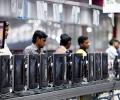
It was expected that supplies from China will be back to normal by end-June as their factories are now operating at nearly 90 per cent of normal capacity. But the recent issue with shipments has placed an obstacle that manufacturers can't bypass.

The smartphone category as a whole was expected to spend around Rs 1,000 crore on marketing and promotional activities over the next six months, even as India unlocks gradually, said media industry experts. This spending is expected to come down, as firms temper their launches.

People in the know said that from social and digital media campaign teams to communications specialists -- all hands were on deck, and every possible post or campaign with the potential to intensify the crisis, was being tracked.

Govt's e-commerce portal asks sellers to specify country origin of products. Now, the commerce & industry ministry has mandated that the Government e-Marketplace, which has seen Rs 55,048 crore worth of transactions till now, adopt this approach in the interest of creating an 'Aatmanirbhar Bharat'.

According to industry insiders, India has 400 million smartphones and is the world's fastest-growing app market. So the addition or deletion of apps impacts the global valuations of these platforms. "Based on calls given by various local organisations to delete Chinese Apps, there will be an impact," said Blaise Fernandes, director at foreign policy think tank Gateway House. "All of them eventually will go the IPO (initial public offering) route so there would be economic impact also."

Steel, cement, aluminum, fertilisers, tractors, two-wheelers, beverages and carbonated drinks, tyres and FMCG could see demand back to near normal levels by the third or the fourth quarter of the financial year, or even earlier.

After the first draft of the Bill was submitted under a committee chaired by Justice B N Srikrishna in 2018, there were objections raised by businesses, especially on the broad restrictions on cross-border data flow.

Phishing attacks could either be in the form of an email from a trusted source asking for personal information such as passwords, bank details and personal details, or it could mimic an existing website or webpage and trick a user into entering confidential information on the page.

The Confederation of All India Traders has approached Union Home Minister Amit Shah, Union Health Minister Harsh Vardhan, Delhi Lieutenant Governor Anil Baijal, and Chief Minister Arvind Kejriwal, and urged them to shut markets in Delhi.

From fast food and athleisure to ACs, the demand for several non-discretionary items has spiked since May 17, when Lockdown 4.0 was extended till May 31.

From auto, refrigerator, and mobile handset makers to real estate firms, companies are tying up with banks to dole out attractive finance schemes and discounts to make buying more affordable.

Ebix had signed the agreement last year to acquire Gurugram-based Yatra Online for an enterprise value of $338 million (about Rs 2,327 crore) in an all-stock deal. The deal was supposed to conclude in the October-December quarter after regulatory approvals but went through several extensions, according to regulatory filings with the US Securities and Exchange Commission.

In 2019, the growth in sales of the Maggi brand of products surpassed the pre-ban level of 2014, in terms of both volume and value. While, Nestle raised prices of Maggi products by an average 3.1 per cent, its volume rose by 9.6 per cent year-on-year.

Mitron probably would have continued with the free run for quite some time, had it not come to light that the source code of the app was actually developed by a Pakistani developer, reports Neha Alawadhi.
 © 2026 Rediff.com - Investor Information - Advertise with us - Disclaimer - Privacy Policy - Sitemap - Feedback - About us - Terms of use - Grievances